


What Is a Grade 8 Bolt?
A Grade 8 bolt is a type of high-strength fastener that's named after its SAE (Society of Automotive Engineers) grade classification, which is based on its mechanical properties. Hence, "Grade 8" is short for "SAE J429 Grade 8." SAE J429 is one of the most common standards for inch fasteners, and Grade 8 is the highest grade within it
Grade 8 bolts are made of medium-strength carbon or alloy steel and can be finished in a variety of coatings and platings for added corrosion resistance and lubricity.
How to Identify a Grade 8 Bolt
You can identify a Grade 8 bolt by looking at its head markings. An SAE J429 Grade 8 bolt's head marking will show six radial lines like this:
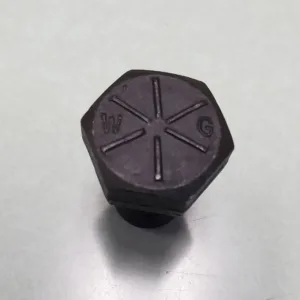
Other bolt grades have a different number of radial lines. For example, SAE J429 Grade 2 has no lines, and Grade 5 has three lines.
As you can also see, the Fastener Quality Act dictates that manufacturers must mark each fastener head with their unique company symbol as well.
How Strong Are Grade 8 Bolts?
Grade 8 bolts are the highest grade of bolts under the SAE J429 standard, which means they have the highest strength. Here are their various strength specifications:
| Specification | Definition | Amount |
| Tensile strength | The maximum amount of force a fastener can withstand before fracturing | ≥ 150,000 PSI |
| Proof load | The minimum amount of force that a fastener must be able to withstand for a given amount of time without permanently deforming | ≥ 120,000 PSI |
| Yield strength | The load that's carried at the point where a fastener permanently deforms | ≥ 130,000 PSI |
But now you might be wondering what those PSI numbers really mean. PSI isn't a measurement we frequently use outside of the manufacturing and engineering world, so let's put some real-world information behind them and convert the measurements into real-world loads.
For example, a ¼" diameter bolt's cross-section area is .0491". If we take the 150,000 PSI and multiply it by .0491", we get 7,365 lbs. So a Grade 8 bolt that's ¼" in diameter should be able to hold a load of roughly 7,365 lbs. Here are some other approximates for parts of other common sizes:
| 1/4″ | 7,350 lbs |
| 3/8″ | 16,500 lbs |
| 1/2″ | 29,400 lbs |
| 5/8″ | 46,000 lbs |
| 3/4″ | 66,200 lbs |
| 1″ | 117,800 lbs |
To expand on this even more, a Chevy Suburban weighs about 5,800 lbs. So, given this information, you could easily support the weight of a Chevy Suburban with just one ¼" Grade 8 bolt. Yes, you read that right.
Here are some other things that weigh in the same neighborhood as these bolts' PSI loads.
| 1/4″ | 7,350 lbs | A Chevy Suburban weighs around 5,800 lbs. |
| 3/8″ | 16,500 lbs | A full-grown African elephant weighs around 15,000 lbs. |
| 1/2″ | 29,400 lbs | Motorhomes/RVs weigh between 15,000-30,000 lbs. |
| 5/8″ | 46,000 lbs | An F-15 fighter jet weighs around 45,000 lbs. |
| 3/4″ | 66,200 lbs | Steel railroad boxcars (empty) weigh between 60,000-70,000 lbs. |
| 1″ | 117,800 lbs | Tanks weigh between 80,000-120,000 lbs. |
With that context, it's easy to understand why Grade 8 bolts are considered high-strength. However, it's also important to keep in mind that they aren't the strongest bolt choice out there. While they may be at the top of the list for SAE J429, there are some other standards and superalloy materials that result in bolts capable of withstanding more extreme conditions.
Common Grade 8 Bolt Applications
High-strength bolts constitute high-strength applications. It wouldn't make sense and frankly would be a waste of money to use a Grade 8 bolt for anything less. You'll commonly see Grade 8 bolts used in industries like:
Military
Heavy machinery
Heavy truck
Aerospace